
AI, Automation, and Physical Services: Why Express Car Wash is Positioned to Benefit from Technology Disruption
Executive Summary
Artificial intelligence is forcing investors to reassess entire sectors.
In many industries, AI is not a distant concept. It is already changing labor needs, pricing power, margins, customer expectations, and long-term enterprise value. Professional services, software, media, customer support, research, marketing, and other knowledge-based sectors are being forced to answer a difficult question:
Does AI work for the business, or against it?
For many categories, the answer is uncertain.
For express car wash, we believe the answer is more compelling.
AI does not replace the need for a physical car wash. A customer still owns a physical vehicle, drives through physical roads, collects physical dirt, pollen, brake dust, bugs, salt, grime, and weather-related buildup, and needs a physical service performed in a convenient local location.
AI cannot wash a car through a screen.
But AI can make a car wash platform smarter.
It can improve site selection, marketing efficiency, pricing strategy, customer segmentation, membership retention, labor planning, operating consistency, predictive maintenance, and customer service.
For AquaSonic, AI is not an existential threat. It is an operating advantage.
The New Investment Question: Does AI Help or Hurt?
Investors are increasingly evaluating portfolio exposure through the lens of AI disruption.
In some sectors, AI may create meaningful pressure:
Labor-intensive professional services may see pricing compression.
Certain software categories may face faster commoditization.
Customer service models may be restructured.
Marketing, content, and administrative functions may require fewer people.
Companies built on repeatable knowledge work may need to defend margins more aggressively.
This does not mean those sectors are unattractive. But it does mean investors must think carefully about whether AI strengthens or weakens the underlying business model.
The question is no longer simply, “Can this company use AI?”
The better question is, “Does AI improve the value of this business, or does it reduce the need for it?”
In express car wash, we believe the answer is clear: AI can improve the platform, but it does not replace the service.
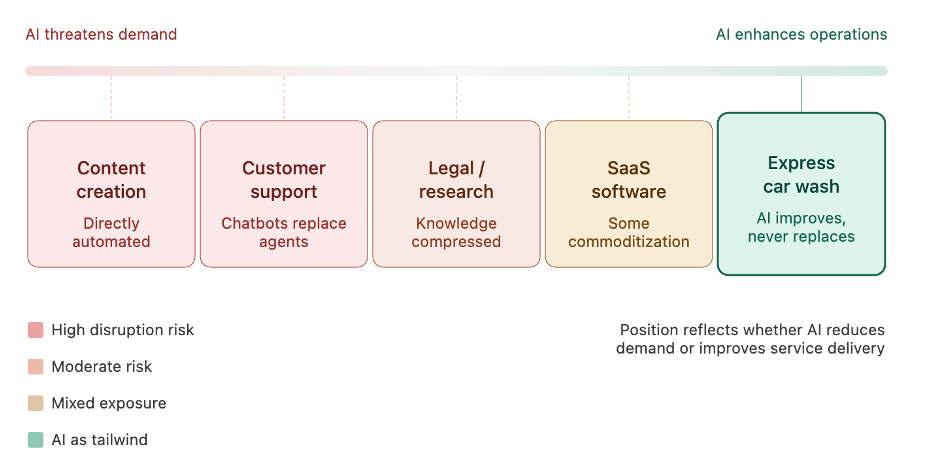
Physical Services Have a Different Kind of Durability
AI is forcing investors to reassess where risk really sits in a portfolio.
Many historically attractive sectors are now facing new questions. Professional services, consulting, legal support, accounting, marketing services, customer support, software, content creation, administrative outsourcing, and other knowledge-based businesses may all be affected by AI’s ability to automate, compress, or commoditize parts of the work.
In some cases, AI may reduce labor needs. In others, it may pressure pricing, lower barriers to entry, or make certain services feel less differentiated. Even strong businesses may need to prove that AI improves their model rather than weakening demand for what they sell.
Physical services have a different durability profile.
Express car wash is tied to real-world behavior. Vehicles still need to be cleaned. Roads still create grime. Weather still creates buildup. Customers still value speed, convenience, shine, protection, and a consistent experience. The service must still happen in a real place, with real equipment, in a real trade area.
A customer cannot outsource a clean vehicle to an AI tool. Amazon cannot ship a washed car to the driveway. A chatbot cannot remove brake dust from wheels, pollen from paint, or lovebugs from a windshield.
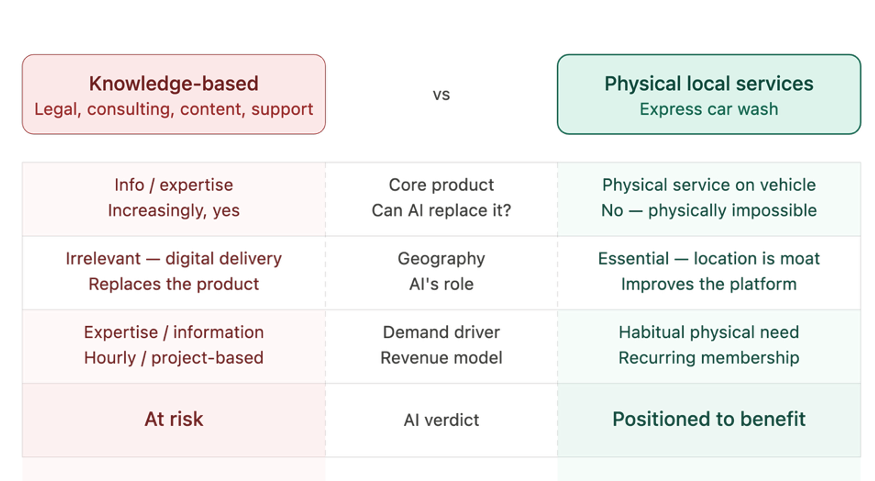
The demand is physical. The delivery is local. The customer behavior is habitual.
That combination matters in a technology-disrupted environment.
The most attractive businesses in the AI era may not be the ones least touched by technology. They may be the ones where technology improves the business without eliminating the need for the product.
That is where AquaSonic is positioned: in a physical service category where AI can strengthen site selection, marketing, pricing, retention, and operations — without replacing the wash itself.
AI Is a Tailwind for Operators with Scale and Data
AI will not help every operator equally.
The greatest benefits will accrue to platforms with the data, discipline, and infrastructure to use technology effectively. For AquaSonic, this is already part of the operating model.
We are not simply building individual car washes. We are building a repeatable system where every site makes the next one smarter.
AquaSonic is already using AI and data-led decision-making across site selection, marketing, customer acquisition, pricing, retention, and operations. As the platform grows, each new site adds more insight into how customers behave, which offers convert, which trade areas perform best, and which operating decisions drive the strongest results.
That creates a compounding advantage.
Site Selection
Car wash is a hyper-local business, and site quality is one of the biggest drivers of performance.
AquaSonic uses AI-supported analysis to evaluate traffic patterns, demographics, household density, income profile, retail adjacencies, visibility, access, competitive positioning, and customer behavior.
Better site intelligence leads to better real estate decisions - and in car wash, better sites can materially improve returns.
Marketing, Pricing, and Membership Growth
AquaSonic also uses data and AI to improve customer acquisition, offer strategy, and membership conversion. The goal is not simply to drive trial. It is to convert local customers into recurring members at an attractive acquisition cost.
AI-supported marketing helps the platform test messaging, evaluate creative performance, refine offers, and understand which channels drive durable membership growth. That learning loop is already visible. Tampa reached approximately 2,000 members in its first month - a milestone that took roughly five months at New Port Richey.
The platform is learning, and the learning is showing up in the numbers.
Retention and Operations
Membership is the core value driver in express car wash. AI and data can help AquaSonic better understand usage patterns, churn risk, reactivation opportunities, plan preferences, and customer segments that respond to specific messaging.
On the operating side, data can support labor planning, throughput, customer service workflows, equipment monitoring, maintenance planning, and site-level decision-making.
For a physical service business, the benefit is not replacing the tunnel.
The benefit is making the entire operating system smarter..
AquaSonic’s Model Is Built for the AI Era
AquaSonic is positioned at the intersection of physical service durability and technology-enabled operating leverage.
The core service is local and physical. The operating model is increasingly data-led.
That combination creates a powerful investment profile:
Durable demand
Recurring membership revenue
Local convenience-based customer behavior
Repeatable site development
Portfolio-level diversification
Data-driven marketing
Technology-enhanced operations
AI-assisted decision-making
This is very different from businesses where AI may reduce demand for the product itself.
In our view, the best question is not whether AI will change car wash. It will. The better question is who benefits from that change.
We believe sophisticated, well-capitalized, data-driven operators will benefit disproportionately.
AI Does Not Replace Local Dominance
One of the reasons express car wash remains attractive is that technology does not eliminate the importance of local convenience. Even with better digital tools, customers still choose a wash based on where they live, commute, shop, and drive. That means the physical site remains critical.
AI may help identify and optimize the best locations, but it does not make the location irrelevant.
This is important for investors. In many digital categories, technology can erase geography. In car wash, geography remains a moat. The best site in the right micro market can continue to hold meaningful local value because the service cannot be delivered remotely.
That is why AquaSonic’s strategy combines technology with disciplined real estate selection. We use data to improve decision-making, but the investment thesis remains grounded in physical-world customer behavior.
The Membership Model Enhances the Technology Opportunity
AI becomes especially valuable when applied to a recurring revenue model.
A one-time retail customer provides a limited relationship. A member creates a longer-term data and engagement opportunity.
Memberships allow the platform to better understand:
Frequency of use
Plan preference
Cancellation behavior
Reactivation opportunities
Promotion sensitivity
Seasonal trends
Local customer patterns
Lifetime value
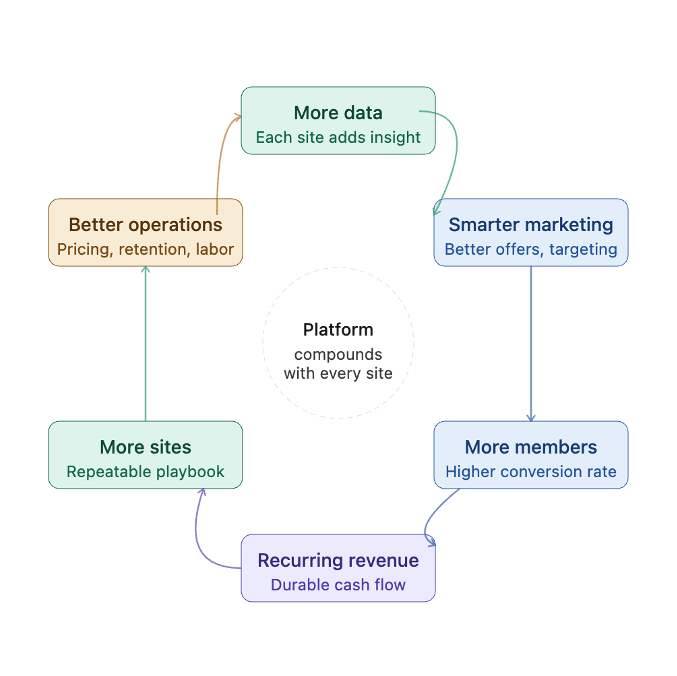
This creates a feedback loop.
Better data improves marketing. Better marketing improves member acquisition. Stronger member acquisition improves recurring revenue. More recurring revenue improves site-level performance. More sites create more data.
That is how the platform compounds.
AquaSonic’s early membership performance is therefore not only an operating metric. It is a data advantage.
Why This Matters for Investors
The investment landscape is changing quickly.
Many sectors that once appeared stable are now facing AI-driven uncertainty. Investors must evaluate whether technology will protect, pressure, or transform the businesses they own.
Express car wash offers a different proposition.
It is a physical, local, recurring-revenue service business where technology can improve the model without replacing the need for the service.
For AquaSonic, this creates a compelling opportunity:
AI helps us choose better sites.
AI helps us acquire customers more efficiently.
AI helps us understand members more deeply.
AI helps us improve operations.
AI helps us scale the platform.
AI does not eliminate the need for a clean car.
That is the difference between disruption risk and technology leverage.
Conclusion
AI is changing the investment environment, but not all businesses are exposed in the same way.
For some sectors, AI may challenge the core value proposition. For others, it may compress margins, increase competition, or reduce the need for certain services altogether.
Express car wash is different.
AquaSonic sits in a category where demand is physical, local, habitual, and convenience-driven. Customers still need a real service, in a real location, for a real vehicle. AI cannot replace the wash.
Which proves the point: AI can support the work. It can sharpen the thinking. It can make the platform smarter, faster, and more efficient. But it cannot deliver the core product.
That is why we believe AquaSonic is well positioned for the next phase of technology-enabled service investing: a business where the product remains essential, the customer relationship becomes recurring, and the operating system improves with every site.
For more information regarding Henley Car Wash and current investment opportunities available to accredited investors, please reach out to [email protected] or visit https://www.aquasoniccw.com/.
